The most expensive week on most development sites is not the one everyone pays attention to. It is the week between when the grading contractor demobilizes and the seeding contractor shows up. On paper, it is a transition. In practice, it is a schedule gap with exposed soil, weather risk, and an open question about who owns the site until the next crew arrives.
This gap shows up repeatedly across the project types that define Eco Express’s work. Utility-scale solar sites across North Carolina, South Carolina, Virginia, and the Eastern US are exposed to stormwater compliance risk during the handoff between civil contractors. Commercial developments run into schedule delays when seeding subcontractors cannot mobilize to match grading completion. Federal and military projects accumulate quality control findings when multiple vendors create documentation and coordination gaps the prime contractor has to absorb.
The integrated site stabilization model Eco Express operates was built specifically to eliminate this gap. This article explains how it works in practice, where it delivers the most value, and what the first conversation with Eco Express looks like.
The Hidden Cost of Managing Multiple Vendors from Grading to Seeding
The transition from raw graded earth to established vegetation involves a sequence of work that, on most projects, is contracted across multiple vendors. The grading contractor handles clearing, grubbing, earthwork, and rough grade. A civil contractor handles stormwater features, drainage, and utilities. A seeding contractor handles soil preparation, hydroseeding, and mulch or compost blanket application. Each has its own contract, schedule, project manager, and liability profile.
The visible costs are in the line items. The hidden costs show up at the seams.
Schedule slippage is the most common. If grading finishes a week late, the seeding subcontractor may not be able to re-mobilize for two or three weeks depending on their backlog. Those weeks are paid for by the owner in carrying costs, compliance exposure, and in some cases contract penalties.
Compliance exposure is the second. NPDES permits require stabilization within defined windows after grading stops. If the handoff exceeds that window, the site is in non-compliance regardless of who was contractually responsible.
Coordination overhead is the third. Every interface between two contractors requires a decision about who owns silt fence that needs to remain through seeding, who decommissions haul roads, and who is responsible for erosion that occurred between scopes. These decisions consume project management time and often end up as change orders or disputed costs.
Finger-pointing is the fourth. When a site experiences a failure — a stormwater violation, a failed stand, a blown-out slope — the first question is whose scope the failure belongs to. That conversation rarely ends cleanly when multiple vendors share the sequence.
What an Integrated Site Stabilization Model Looks Like in Practice
Eco Express operates an integrated model that combines site grading, civil construction preparation, and seeding under a single operation. One contract. One project manager. One mobilization. One point of accountability from raw ground to established vegetation.
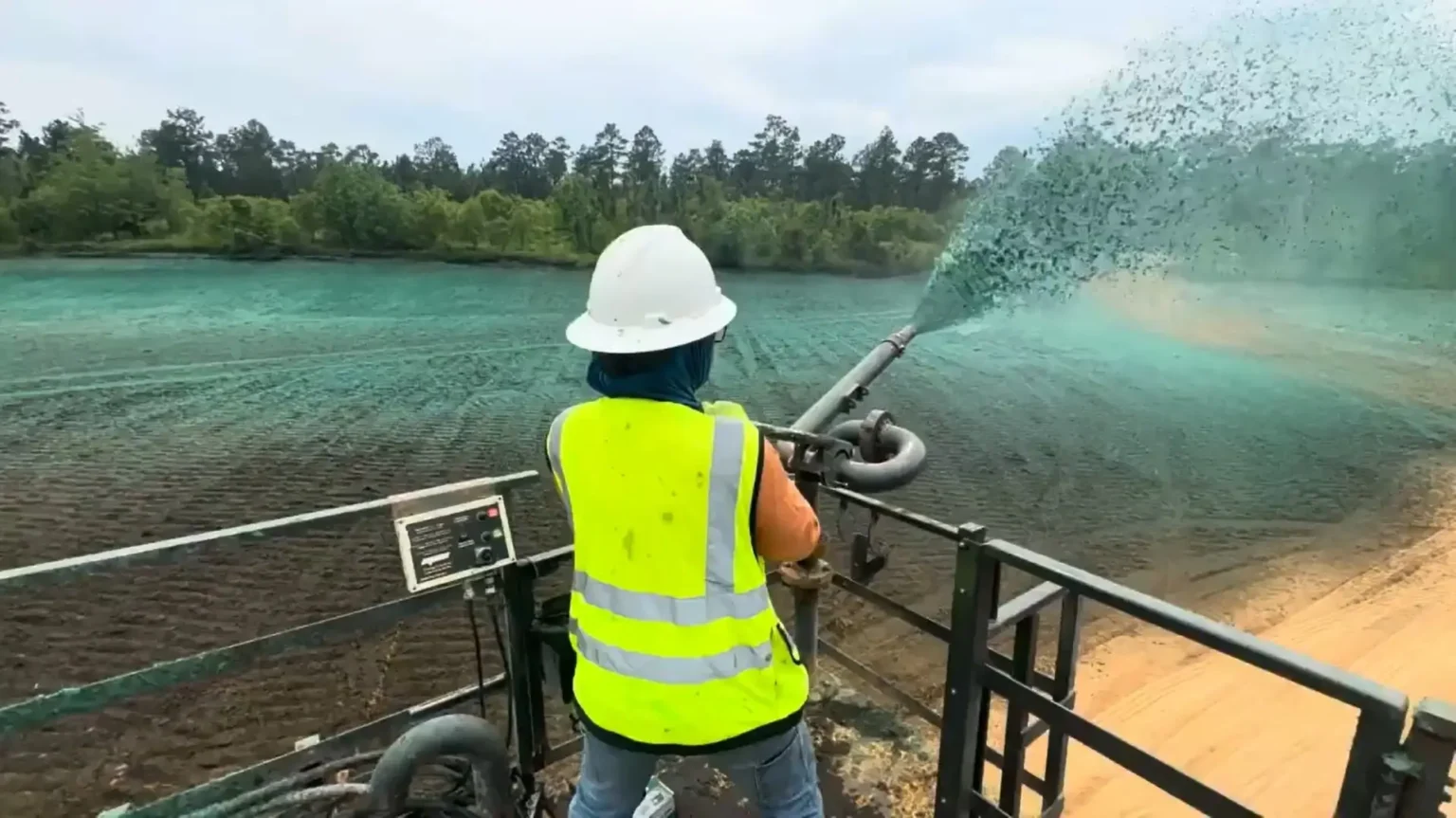
In practice, this means the same operational team that handles the clearing, grubbing, and grading also handles the soil preparation, hydroseeding, compost blanket application, and any specialized erosion control techniques the site requires. Soil revitalization using CarbonizPN from Mirimichi Green is sequenced into the work plan at the point where it produces the best establishment outcome, not as an afterthought negotiated between two vendors. Compost blankets are applied as soon as slopes are ready to receive them, rather than waiting on a separate subcontractor’s schedule.
Equipment capacity matches the full scope. Eco Express operates the industrial-scale equipment required for both ends of the sequence, which is what allows the same team to move seamlessly from earthwork to establishment without re-mobilization.
The project management structure is equally important. A single project manager owns the full sequence, maintains the schedule against the overall site timeline, and communicates with the owner, the prime contractor, or the design team as a single point of contact. Documentation — quality control reports, compliance records, inspection logs — is produced by one operation under one format, which simplifies the record the owner carries forward.
How Single-Point Accountability Eliminates Schedule Gaps
The schedule gap between grading and seeding exists because of contract boundaries, not because of engineering necessity. An integrated model eliminates the boundary.
When the same operation is handling grading and seeding, the work plan is sequenced from the outset to transition between phases without a mobilization gap. Slopes that are ready for stabilization get it immediately, rather than waiting for a separate contractor to arrive. Soil that needs revitalization gets it during the preparation phase, not after the fact. Compost blankets are applied before the first major weather event, not after the site has sat exposed for two weeks.
The practical effect on the schedule is measurable. Projects that would otherwise lose weeks at the grading-to-seeding transition move through stabilization on the original timeline. NPDES compliance windows are met reliably. Sites that depend on a specific close-out sequence for certificate of occupancy, panel installation, or facility acceptance hit their milestones without the drag that a multi-vendor handoff typically introduces.
The risk profile also changes. With a single point of accountability, there is no dispute over whose scope a failure belongs to, because the scope has not changed hands. Remediation, if required, is handled within the existing contract rather than becoming a three-way negotiation. For the owner or prime contractor, that is a substantial simplification of the risk management problem on a large site.
Project Types That Benefit Most from an Integrated Approach
Not every project requires integrated grading and seeding. Small sites with simple soil conditions and lenient schedules may be well served by a conventional multi-vendor approach.
The projects where the integrated model delivers the most value share three characteristics. They are large in footprint, with sequencing complexity that amplifies the cost of vendor handoffs. They are under timeline pressure, with contractual or regulatory milestones that leave no room for schedule slippage at the transition points. And they carry compliance exposure, typically through an NPDES permit, a federal specification, or a lender’s requirements, where bare soil is a direct liability.
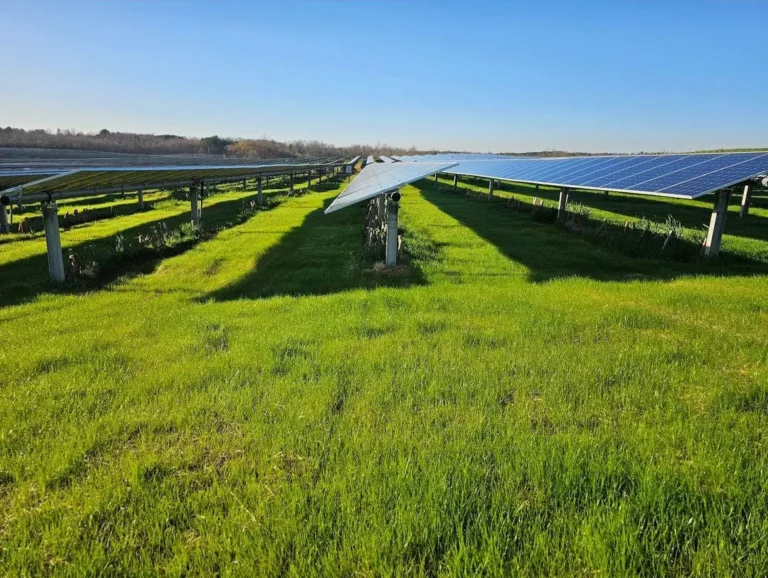
Utility-scale solar projects fit this profile consistently. The sites are hundreds of acres. The schedules are driven by interconnection timelines and power purchase agreement deadlines. The compliance exposure is significant across the grading-to-establishment sequence. Solar developers across North Carolina, South Carolina, Virginia, and the Eastern US are among the most frequent beneficiaries of an integrated approach.
Commercial real estate developments fit this profile as well. Debt carrying costs, opening date commitments, and certificate of occupancy sequencing all create timeline pressure that the grading-to-seeding handoff tends to disrupt on a conventional arrangement.
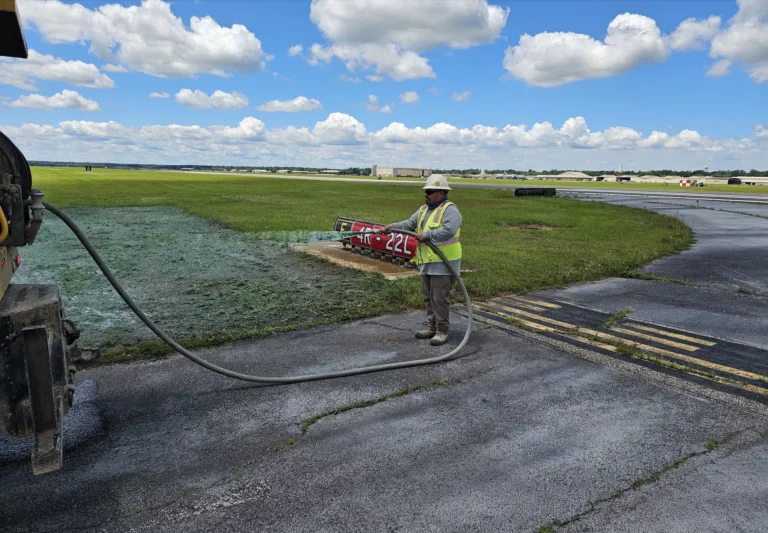
Government and military infrastructure projects fit this profile in a different way. The premium on specification compliance, CPARS performance, and documentation discipline means that reducing the number of subcontractors in the sequence reduces the number of places where prime contractor performance can be affected by subcontractor error.
What Your First Conversation with Eco Express Looks Like
The first conversation is a working discussion, not a sales pitch. It starts with the site, the timeline, and the compliance environment, and it produces a specific recommendation for how to approach the work.
The topics that matter are straightforward. Site size and geography. Soil conditions after grading, or expected conditions based on the survey and civil plans. Schedule, and the hard milestones within it. Regulatory environment — NPDES, state-level stormwater, federal specification, or a combination. Specialized techniques the site may require, including compost blankets, grass pavers, site-specific seed mixes, and soil revitalization. The prime contract structure and how an erosion control or integrated scope fits within it.
From that conversation, Eco Express develops a tailored plan that addresses soil health, erosion control, and compliance from the grading phase through final vegetation establishment. The company has been structuring this kind of engagement for clients across the Eastern US since 2003, with a consistent approach across utility-scale solar, commercial, and federal work.
For developers, project managers, and prime contractors who have absorbed the cost of a multi-vendor sequence one too many times, the integrated model is the practical alternative.
Ready to eliminate the vendor handoff gap on your next project? Contact Eco Express to discuss an integrated grading-to-establishment scope for your site across North Carolina, South Carolina, Virginia, and the Eastern US.
Frequently Asked Questions
What does Eco Express mean by “integrated site stabilization”?
Integrated site stabilization combines site grading, civil construction preparation, soil revitalization, and seeding under a single contract and a single operational team. One project manager owns the sequence from raw ground to established vegetation, one mobilization covers the full scope, and one documentation format supports compliance and quality control. This structure eliminates the schedule gap, coordination overhead, and accountability ambiguity that typically occurs at the handoff between separate grading and seeding contractors.
What types of projects benefit most from an integrated approach?
Projects with large footprints, tight timelines, and active compliance exposure benefit the most. This profile applies consistently to utility-scale solar developments, large commercial real estate projects, and federal or military infrastructure work. In each of these contexts, the cost of a multi-vendor handoff — measured in schedule slippage, compliance exposure, and coordination overhead — is significant relative to the premium on an integrated scope. Smaller projects with simple conditions and forgiving schedules may be well served by a conventional multi-vendor arrangement.
How does an integrated model reduce project risk?
With a single contractor responsible for the full grading-to-establishment sequence, there is no contractual boundary at the point where failures most often occur. Stabilization is sequenced to meet NPDES windows without a mobilization gap. Documentation is produced under a single format that supports compliance and quality control review. When issues arise, remediation is handled within the existing contract rather than becoming a multi-vendor dispute. For owners, prime contractors, and project managers, the net effect is a simpler risk profile and a lower probability of schedule-disrupting failures at the seams between scopes.
Does Eco Express have the equipment capacity for large-scale projects?
Yes. Eco Express operates industrial-scale equipment designed for utility-scale and government projects and routinely handles multi-hundred-acre sites across North Carolina, South Carolina, Virginia, and the broader Eastern US. Equipment capacity covers both the grading end of the sequence and the hydroseeding, compost blanket, and soil revitalization end, which is what allows the company to execute the integrated model without re-mobilizing between phases. The company has been operating at this scale since 2003.
How do I get started with Eco Express?
Every engagement starts with a working conversation about the specific site, the schedule, the regulatory environment, and the contract structure. From there, Eco Express develops a tailored plan that addresses soil health, erosion control, and compliance from the grading phase through final vegetation establishment. There is no generic service package. The plan is built around the project, using the combination of grading, hydroseeding, compost blankets, soil revitalization with CarbonizPN from Mirimichi Green, and specialized techniques that fit the site.