Few things stall a commercial development faster than a failed stormwater inspection. The grading is finished, the crews are ready to pour footings, and a notice of violation from the state environmental agency brings everything to a halt. Exposed soil on a disturbed site has triggered a compliance issue, the project is now in remediation mode, and the schedule you committed to your investors is slipping by the week.
For commercial real estate developers working across North Carolina, South Carolina, and Virginia, NPDES stormwater compliance is not a procedural afterthought. It is one of the most common sources of project delays, budget overruns, and reputational risk on any site over one acre. And because each state administers its own permitting framework under the broader federal program, developers with projects in multiple markets face an operational complexity that is easy to underestimate.
This guide outlines what developers need to know about NPDES requirements in the Carolinas and Virginia, where compliance most often breaks down, and how the right erosion control approach keeps sites moving from disturbed ground to certificate of occupancy without regulatory interruption.
Understanding NPDES Permit Requirements for Commercial Development Sites
The National Pollutant Discharge Elimination System, or NPDES, is the federal program established under the Clean Water Act to regulate discharges of pollutants into waters of the United States. For commercial construction, the relevant mechanism is the Construction General Permit, which applies to any site that disturbs one or more acres of land, or less than one acre if the site is part of a larger common plan of development.
The permit requires developers to prepare and implement a Stormwater Pollution Prevention Plan, typically referred to as a SWPPP. This document identifies the site-specific erosion and sediment controls that will be used during construction, assigns responsibility for inspections, and sets out the stabilization benchmarks the site must meet at each stage of disturbance.
At a practical level, NPDES compliance requires that exposed soil be stabilized within a defined window after grading activity stops. The specific timeframe depends on the state and the site’s proximity to impaired waters, but the concept is consistent. Bare soil is a regulatory liability. Until it is stabilized with vegetation, erosion control blankets, or an approved alternative, the site is exposed to inspection risk every day.
How Stormwater Regulations Differ Across North Carolina, South Carolina, and Virginia
While NPDES is a federal program, the Environmental Protection Agency delegates administration to state agencies in each jurisdiction. North Carolina, South Carolina, and Virginia each run their own permitting process with distinct rules, forms, and inspection protocols.
North Carolina administers construction stormwater through the Department of Environmental Quality, with the Division of Energy, Mineral, and Land Resources overseeing sediment and erosion control plan approval. The state requires a separate Sediment and Erosion Control Plan in addition to the NPDES Construction General Permit for most commercial projects, and plan approval is a prerequisite to beginning land-disturbing activity.
South Carolina operates its program through the Department of Environmental Services, which issues coverage under a state-wide Construction General Permit and reviews SWPPPs as part of the coverage process. Inspection frequency and documentation requirements are codified in the general permit itself and enforced by regional staff.
Virginia administers its construction stormwater program through the Department of Environmental Quality, with a notable emphasis on the Erosion and Sediment Control regulations administered at the local level. Local program authorities in Virginia often have their own plan review and inspection protocols that sit alongside the state-level requirements.
For developers with projects across all three states, the practical implication is that every new project requires engagement with a different permitting authority, a different plan review process, and different inspection expectations. Underestimating this complexity is one of the most common causes of early-stage project delays.
Common Compliance Failures That Cause Project Delays and Fines
Across the Carolinas and Virginia, a consistent set of compliance failures accounts for most enforcement actions and project delays on commercial sites.
The first is delayed stabilization. Grading finishes, the next phase of construction is not yet mobilized, and the site sits exposed beyond the permitted stabilization window. By the time the seeding or erosion control contractor arrives, the site has already accumulated inspection exposure. This is one of the clearest arguments for an integrated grading-to-seeding scope that removes the handoff entirely.
The second is failed vegetation establishment. Seed is applied, but the site does not achieve the density of ground cover required to count as stabilized within the permit timeframe. This is especially common on sites with depleted or compacted soil, where conventional hydroseeding alone does not produce reliable results.
The third is inadequate perimeter and slope protection. Silt fence that is improperly installed or not maintained, check dams that have failed, or slopes that lack adequate cover all generate inspection findings that can escalate quickly if not corrected on the spot.
The fourth is documentation gaps. SWPPPs that are not updated after changes to the site plan, inspection logs that are incomplete, or post-storm inspections that were not conducted or recorded all create paper-trail vulnerabilities that inspectors can and do cite.
Any of these failures can trigger a notice of violation, a stop-work order, or a civil penalty. The time required to remediate a violation and secure re-inspection is rarely less than a week and can extend significantly longer on complex sites.
Erosion Control Techniques That Satisfy Environmental Inspectors
Reliable NPDES compliance on commercial sites comes down to selecting erosion control techniques that establish stabilization quickly, maintain it through the construction sequence, and produce the documentation inspectors expect.
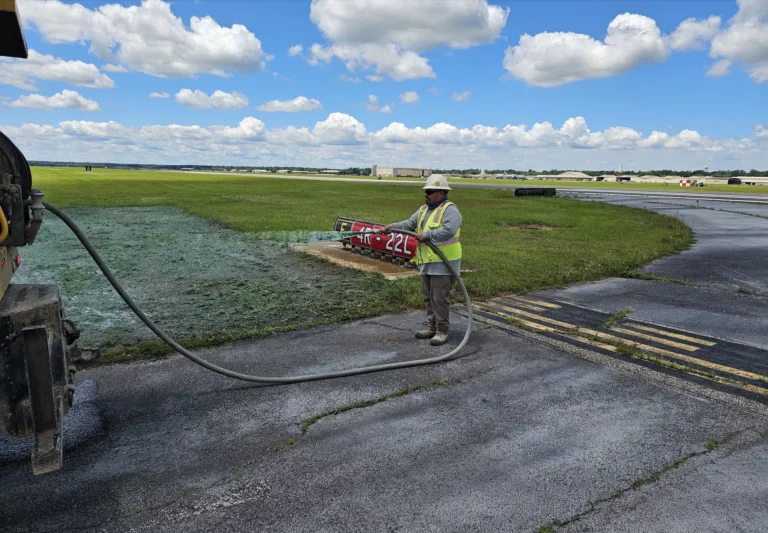
Hydroseeding is the workhorse of commercial site stabilization. When properly specified, it combines seed, mulch, tackifier, and soil amendments in a single application that promotes rapid germination and ground cover. The quality of the underlying soil determines how reliably hydroseeding establishes vegetation, which is why soil preparation matters as much as the application itself.
Compost blankets provide immediate surface protection on slopes and high-risk areas while vegetation establishes underneath. Unlike straw mulch, compost blankets contribute organic matter and beneficial microbial activity to the soil, accelerating the transition to permanent ground cover. Eco Express has pioneered the use of high-performance compost blankets on commercial and industrial sites across the Eastern US.
Soil amendments such as CarbonizPN from Mirimichi Green address the biological deficit on sites where topsoil has been stripped during grading. Restoring microbial activity before or during seeding dramatically improves the odds of achieving stabilization benchmarks on the first application, rather than requiring the re-seeding cycles that drive schedule slippage.
For developers, the objective is not simply to place material on the ground. It is to achieve inspection-ready stabilization within the permit window and hold it until the site is built out.
How the Right Erosion Control Partner Keeps Your Project on Schedule
A good erosion control partner on a commercial development does three things. They arrive on schedule, they apply the right technique for the soil and slope conditions on your site, and they produce documentation that supports your compliance record.
Mobilization timing is where many schedules quietly break down. If grading finishes on a Thursday and the seeding contractor cannot get on site until the following Wednesday, the stabilization clock has already been running for five days. Contractors with the equipment capacity and operational bandwidth to mobilize quickly across North Carolina, South Carolina, and Virginia are the ones who protect their clients’ schedules.
Technique selection is equally important. The same slope that performs fine with hydroseeding in July may need a compost blanket in November. The same subsoil that grows grass in one county may need CarbonizPN treatment in another. A partner who understands these differences and specifies accordingly is the difference between first-attempt stabilization and a re-application cycle.
Eco Express has served commercial developers across the Carolinas and Virginia since 2003. The company combines high-capacity hydroseeding, pioneering compost blanket technology, and exclusive use of CarbonizPN for soil revitalization, all managed from a single operational footprint that spans the three-state region. For developers who need stormwater compliance to stop being a recurring source of schedule risk, that integrated capability is the practical solution.
Are stormwater permits putting your commercial project timelines at risk? Contact Eco Express to discuss your site plan and stabilization requirements across North Carolina, South Carolina, and Virginia.
Frequently Asked Questions
What is an NPDES permit and when is it required?
The National Pollutant Discharge Elimination System, or NPDES, permit is required under the federal Clean Water Act for construction sites that disturb one or more acres of land, or any smaller site that is part of a larger common plan of development. It regulates stormwater discharges to prevent sediment and pollutants from reaching waters of the United States during and after construction. Coverage is typically obtained through a state-administered Construction General Permit and requires the preparation of a Stormwater Pollution Prevention Plan specific to each site.
What happens if a development site fails a stormwater inspection?
A failed inspection can result in a notice of violation, a stop-work order, required remediation, and in some cases civil penalties. Remediation typically requires correcting the deficiency, allowing vegetation or erosion controls to establish, and then requesting a re-inspection. The time required to clear a violation is rarely less than a week and can add weeks or months to a project schedule on complex sites, with corresponding increases in carrying costs and contractor standby charges.
Are stormwater regulations the same across all three states?
No. While NPDES is a federal program, each state administers its own permitting process with distinct thresholds, plan approval workflows, inspection protocols, and documentation requirements. North Carolina, South Carolina, and Virginia each have separate regulatory agencies with their own procedures. Developers working across multiple states need either internal expertise in each jurisdiction or a contractor partner with direct, ongoing experience across all three programs.
How does hydroseeding help with stormwater compliance?
Hydroseeding applies seed, mulch, tackifier, and soil amendments in a single pass that promotes rapid germination and establishes ground cover within the timeframes required by NPDES permits. Established vegetation is one of the most effective and durable forms of erosion control, stabilizing soil, slowing runoff, and filtering sediment. On properly prepared soil, hydroseeding is the fastest reliable path to meeting the stabilization benchmarks that trigger compliance closure on a disturbed site.
Can Eco Express handle compliance across multiple state jurisdictions?
Yes. Eco Express operates across North Carolina, South Carolina, and Virginia and has extensive experience navigating the specific regulatory requirements in each state. The company has worked with commercial developers, site civil engineers, and environmental consultants in all three markets since 2003, and brings the equipment capacity, technical expertise, and documentation discipline required for multi-state portfolios. This cross-jurisdictional experience is particularly valuable for developers running concurrent projects in different states.