Silt fence is the first measure an inspector looks for, and one of the most common reasons a site gets written up. Most failures trace back to the install — fabric that was never properly keyed into a trench, posts set too far apart for the load, ends that were never turned uphill. Put it in right and it does its job. Put it in wrong and you are cleaning up sediment and explaining yourself.
Eco Express installs and removes perimeter sediment control on solar farms, military installations, pipeline corridors, transportation projects, industrial plants, and private developments across North Carolina, South Carolina, and Virginia. We have been doing erosion and sediment control work in this region since 2003.
Keeping disturbed soil inside the limits of disturbance on active grading, clearing, and construction sites.
Protecting streams, wetlands, ditches, and stormwater conveyances on sites near sensitive receiving waters.
Meeting the measures shown on your approved E&SC plan through construction, inspection, and final stabilization.
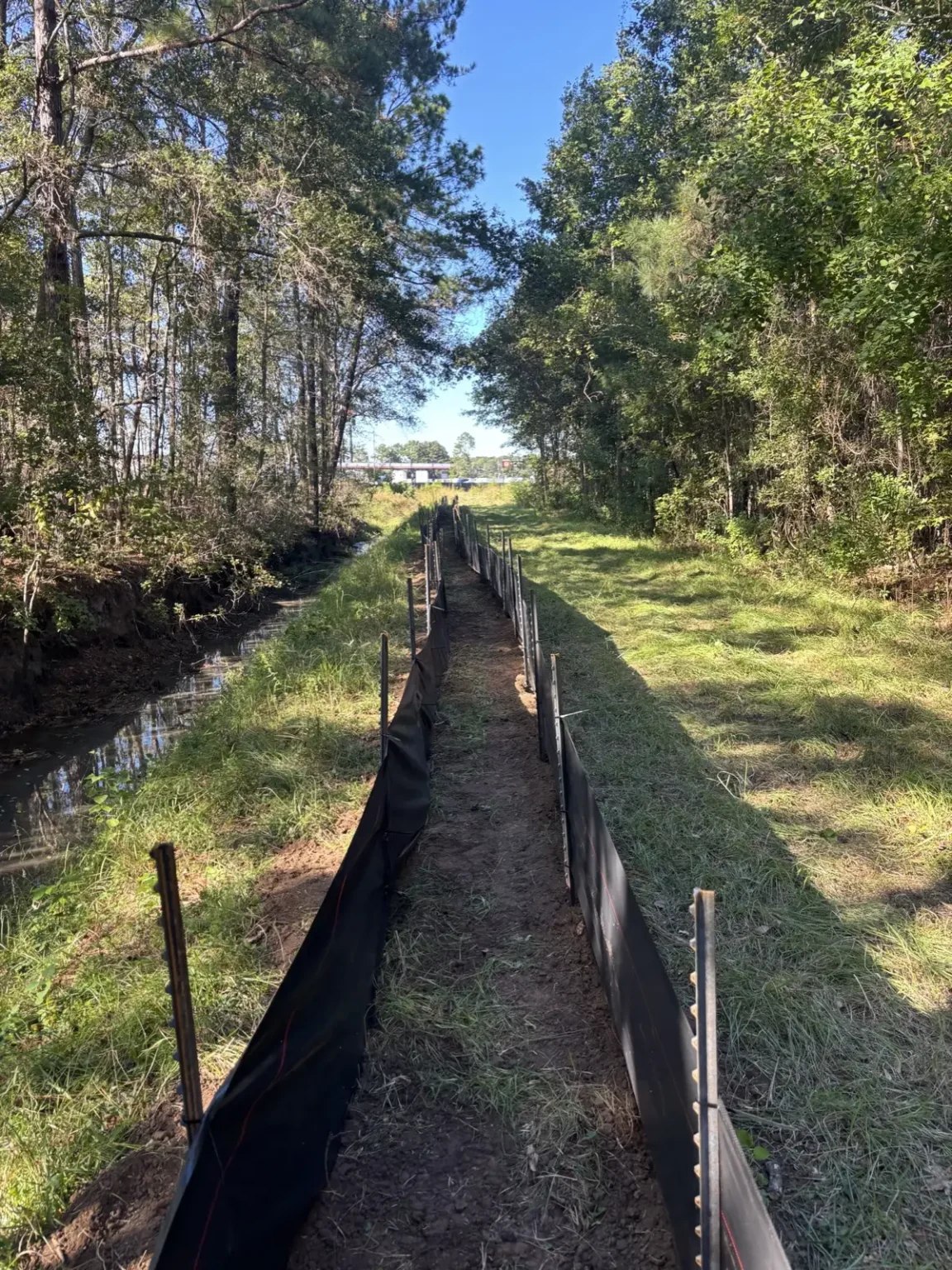
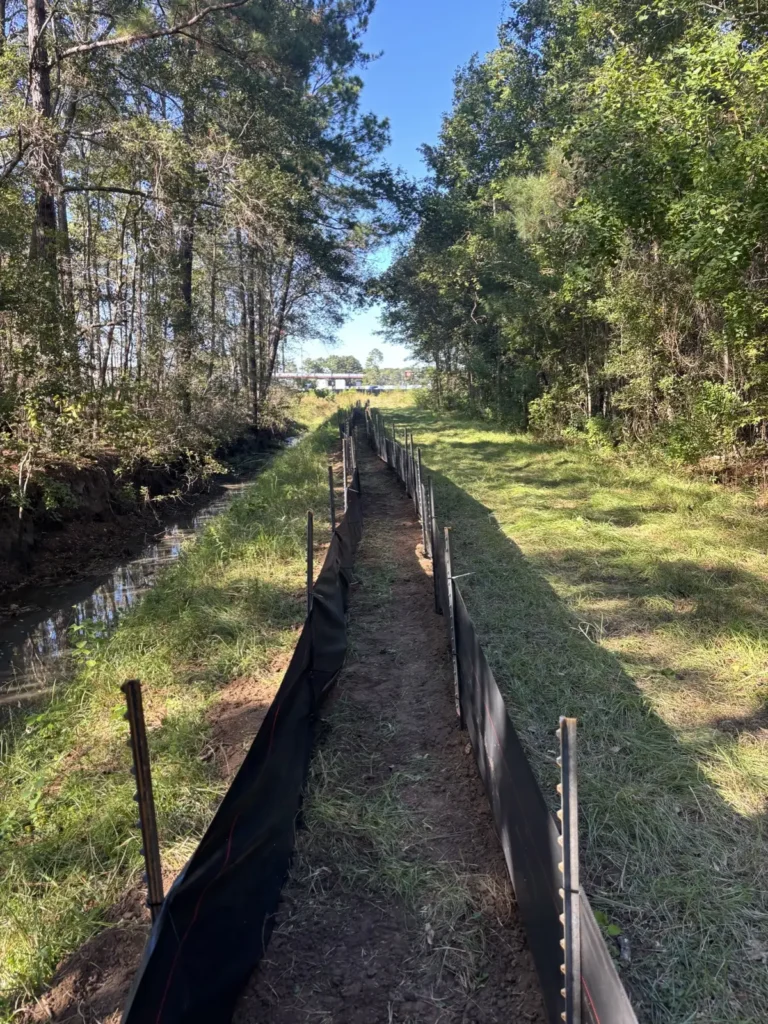
A silt fence is a temporary sediment barrier made of geotextile filter fabric, supported by posts and keyed into a trench along the downslope perimeter of disturbed ground. When runoff reaches it, the fence ponds the water and slows it down. Soil particles settle out of the slowed water, and the water itself passes through the fabric and continues downslope.
That distinction matters: a silt fence is a sediment control, not an erosion control. It catches soil that has already moved. It does nothing to stop soil from moving in the first place — that is the job of ground cover. Perimeter fence is why sediment stays on your site; hydroseeding, seed and straw, and erosion control blankets and matting are why it stops moving at all. Sites that lean on the fence alone tend to spend the whole job cleaning it out.
Silt fence also has limits that are easy to exceed. It is designed for sheet flow from small drainage areas — generally about a quarter acre of drainage per 100 linear feet of fence — not for concentrated flow. Put it across a drainage way or at the bottom of a long, steep slope and it will fail, usually in the first real storm. Where flow concentrates, the answer is a silt fence outlet, a sediment trap, or a different measure entirely.
Two things are worth being clear about before you bid the job.
We install and we remove. We do not maintain. Ongoing maintenance — cleaning out accumulated sediment, repairing storm damage, keeping the fence standing between now and stabilization — is not part of our scope, on our own installations or anyone else’s. Plan for it with your own crews or another contractor.
Removal and trench restoration are included. Once the drainage area is permanently stabilized and the measure has been released, we pull the fence, take the posts out, haul the material off, and regrade and seed the trench line. Timing matters as much here as it does at install: pull the fence before ground cover is established and you create the very discharge the permit was written to prevent; leave it in and it becomes a punch-list item standing between you and permit closeout.
In between, the inspection obligation sits with the permit holder. Under North Carolina’s NCG010000 construction stormwater general permit, erosion and sediment control measures must be inspected at least once every seven calendar days, and within 24 hours of a rainfall event of 1.0 inch or more in a 24-hour period, with records kept. Idle sites move to a 14-day cycle. South Carolina and Virginia impose their own inspection and recordkeeping requirements under their construction general permits.
North Carolina. Work falls under the Sedimentation Pollution Control Act, administered by NCDEQ’s Division of Energy, Mineral and Land Resources along with the NCG010000 general permit — and in delegated jurisdictions, by a local program with its own review. Design and installation follow the NC Erosion and Sediment Control Planning and Design Manual.
South Carolina. Erosion and sediment control and construction stormwater are administered by the South Carolina Department of Environmental Services (SCDES), which took over these programs from DHEC in 2024.
Virginia. Erosion control and stormwater management were consolidated under the Virginia Erosion and Stormwater Management Act and 9VAC25-875, effective July 2024, administered by Virginia DEQ and local VESMP authorities. Virginia’s criteria likewise limit silt fence to roughly a quarter acre of drainage per 100 feet, with a maximum slope length of 100 feet behind the barrier.
Eco Express holds Highway Heavy (H/H) Unlimited General Contractor’s licenses in all three states. Our Director of Safety and Compliance — with the company 20 years — keeps our work aligned with local, state, and federal requirements, including the Clean Water Act and NPDES permit conditions. Our team includes Certified Erosion & Sediment Control / Stormwater Installers, and we are a corporate member of the International Erosion Control Association.
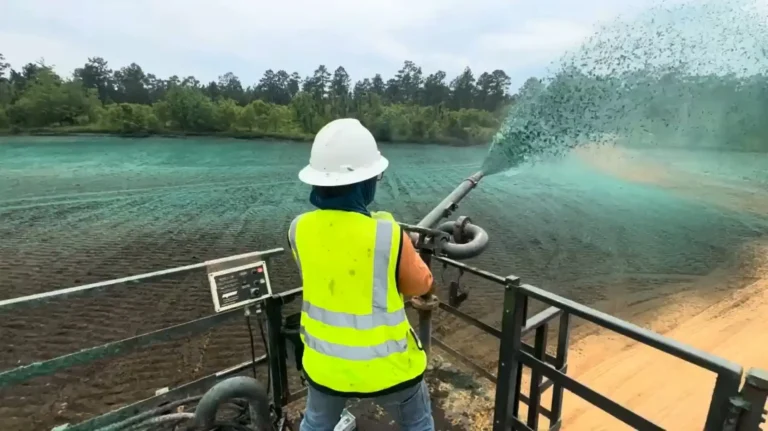
One contractor from grading through green. We self-perform site preparation and grading, erosion control, hydroseeding, and soil revitalization. Perimeter control, ground cover, and final stabilization run on one schedule, under one contract, with nobody waiting on anybody.
Silt fence on its own. Most of our fence work is one line item inside a larger site package, but we will take a standalone silt fence job when it is big enough to mobilize for. Describe the site and we will tell you quickly whether it is a fit.
Fast mobilization. Erosion control is rarely planned work. When a storm, an inspection, or a sequencing change puts fence on the critical path, we move.
Documentation you can hand to an inspector. Near-real-time photos and daily field updates from every crew on every site.
Twenty-plus years in these soils. Coastal sand, Piedmont clay, and everything between, since 2003.
Explore a selection of the erosion control and site stabilization projects Eco Express has completed across the Carolinas, Virginia, and the coastal Eastern US.
Ready to discuss your project?
Your approved E&SC plan governs, but the general design rule in both North Carolina and Virginia is no more than about a quarter acre of drainage area per 100 linear feet of fence. Long slopes, steep grades, and concentrated flow all reduce what a single run of fence can handle, and usually mean adding outlets, breaking the run into segments, or using a different measure. We are glad to walk a site and tell you what the plan actually requires.
Eco Express installs all three. Standard silt fence is filter fabric on driven posts. Wire-backed (reinforced) silt fence adds a wire mesh support fence behind the fabric, which stands up to greater loading and allows wider post spacing — in North Carolina, up to 8 feet rather than 6. Super silt fence uses chain link backing for the most demanding locations. Which one you need is usually set by the approved plan; where it is not, it comes down to drainage area, slope, and how long the fence has to stand.
We take standalone silt fence jobs, as long as they are big enough to mobilize for. Plenty of our fence work is one line item inside a larger site package — grading, seeding, stabilization — but we will quote fence on its own. Call and describe the site and we will tell you quickly whether it is a fit.
Under the NCG010000 construction stormwater general permit, measures must be inspected at least once every seven calendar days and within 24 hours of a rainfall event of 1.0 inch or more in a 24-hour period, with records kept. Idle projects shift to once every 14 calendar days plus the same post-rainfall inspection. South Carolina and Virginia have their own requirements under their construction general permits. That inspection obligation sits with the permit holder — Eco Express installs and removes fence, but does not perform ongoing inspection or maintenance.
After the drainage area has been permanently stabilized and the measure has been released by the reviewing authority. Removing it early risks a discharge and a violation; leaving it in place is a common holdup at permit closeout. When we remove fence, we pull the posts, haul the material off, and regrade and seed the trench line — that restoration is part of the job, not an extra.
No. Our silt fence work is for commercial, industrial, and large-scale projects — construction sites, solar, military, utility, transportation, and private developments. We are not set up for single-family residential lots.
No, and to be straight with you, we do not maintain our own installations either. We install silt fence and we remove it once the site is stabilized. Sediment cleanout, storm repair, and ongoing upkeep in between are not part of our scope, so you will want your own crews or another contractor for that piece.
Ready to discuss your project? Fill out our online contact form for a consultation and we’ll be in touch.
418 Hermitage Road
Castle Hayne, NC 28429
North Carolina, South Carolina, Virginia, and the coastal Eastern US.